nació en 1900, cuando varios investigadores de la reproducción de las plantas descubrieron el trabajo del monje austriaco Gregor Mendel, que aunque fue publicado en 1866 había sido ignorado en la práctica.
Mendel, que trabajó con la planta del guisante (chícharo o arveja), describió los patrones de la herencia en función de siete pares de rasgos contrastantes que aparecían en siete variedades diferentes de esta planta. Observó que los caracteres se heredaban como unidades separadas, y cada una de ellas lo hacía de forma independiente con respecto a las otras. Señaló que cada progenitor tiene pares de unidades, pero que sólo aporta una unidad de cada pareja a su descendiente.
Los cromosomas varían en forma y tamaño y, por lo general, se presentan en parejas. Los miembros de cada pareja, llamadoscromosomas homólogos, tienen un estrecho parecido entre sí. La mayoría de las células del cuerpo humano contienen 23 pares de cromosomas.
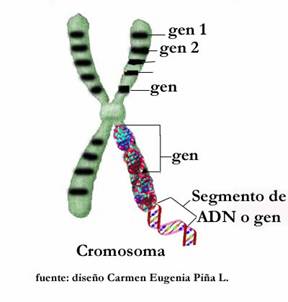 Rara vez la acción de los genes es cuestión de un gen aislado que controla un solo carácter. Con frecuencia un gen puede controlar más de un carácter, y un carácter puede depender de muchos genes.Los caracteres que se expresan como variaciones en cantidad o extensión, como el peso, la talla o el grado de pigmentación, suelen depender de muchos genes, así como de las influencias del medio.
El principio de Mendel según el cual los genes que controlan diferentes caracteres son heredados de forma independiente uno de otro es cierto sólo cuando los genes existen en cromosomas diferentes.Después de que la ciencia de la genética se estableciera y de que se clarificaran los patrones de la herencia a través de los genes, las preguntas más importantes permanecieron sin respuesta durante más de cincuenta años: ¿cómo se copian los cromosomas y sus genes de una célula a otra, y cómo determinan éstos la estructura y conducta de los seres vivos? A principios de la década de 1940, dos genetistas estadounidenses, George Wells Beadle y Edward Lawrie Tatum, proporcionaron las primeras pistas importantes. Trabajaron con los hongos Neurospora y Penicillium, y descubrieron que los genes dirigen la formación de enzimas a través de las unidades que los constituyen. Cada unidad (un polipéptido) está producida por un gen específico. Este trabajo orientó los estudios hacia la naturaleza química de los genes y ayudó a establecer el campo de la genética molecular.
 Desde hace tiempo se sabe que los cromosomas están compuestos casi en su totalidad por dos tipos de sustancias químicas, proteínas y ácidos nucleicos . En parte debido a la estrecha relación establecida entre los genes y las enzimas, que son proteínas, al principio estas últimas parecían la sustancia fundamental que determinaba la herencia. Sin embargo, en 1944, el bacteriólogo canadiense Oswald Theodore Avery demostró que el ácido desoxirribonucleico (ADN) era el que desempeñaba esta función. Extrajo el ADN de una cepa de bacterias y lo introdujo en otra cepa. La segunda no sólo adquirió las características de la primera, sino que también las transmitió a generaciones posteriores. Por aquel entonces, se sabía que el ADN estaba formado por unas sustancias denominadas nucleotidos. Cada nucleótido estaba compuesto a su vez por un grupo fosfato, un azúcar conocido como desoxirribosa, y una de las cuatro bases que contienen nitrógeno. Las cuatro bases nitrogenadas son adenina (A), timina (T), guanina (G) y citosina (C).
En 1953, el genetista estadounidense James Dewey Watson y el británico Francis Harry Compton Crick aunaron sus conocimientos químicos y trabajaron juntos en la estructura del ADN. Esta información proporcionó de inmediato los medios necesarios para comprender cómo se copia la información hereditaria.Watson y Crick descubrieron que la molécula de ADN está formada por dos cadenas, o filamentos, alargadas que se enrollan formando una doble hélice, algo parecido a una larga escalera de caracol.Las cadenas, o lados de la escalera, están constituidas por moléculas de fosfato e hidratos de carbono que se alternan.
 Las bases nitrogenadas, dispuestas en parejas, representan los escalones.Cada base está unida a una molécula de azúcar y ligada por un enlace de hidrógeno a una base complementaria localizada en la cadena opuesta.La adenina siempre se vincula con la timina, y la guanina con la citosina.
Las bases nitrogenadas, dispuestas en parejas, representan los escalones.Cada base está unida a una molécula de azúcar y ligada por un enlace de hidrógeno a una base complementaria localizada en la cadena opuesta.La adenina siempre se vincula con la timina, y la guanina con la citosina.
Para hacer una copia nueva e idéntica de la molécula de ADN, sólo se necesita que las dos cadenas se extiendan y se separen por sus bases (que están unidas de forma débil); gracias a la presencia en la célula de más nucleótidos, se pueden unir a cada cadena separada bases complementarias nuevas, formando dos dobles hélices.
Si la secuencia de bases que existía en una cadena era AGATC, la nueva contendría la secuencia complementaria, o “imagen especular”, TCTAG. Ya que la base de cada cromosoma es una molécula larga de ADN formada por dos cadenas, la producción de dos dobles hélices idénticas dará lugar a dos cromosomas idénticos.Desde que se demostró que las proteínas eran producto de los genes, y que cada gen estaba formado por fracciones de cadenas de ADN, los científicos llegaron a la conclusión de que debe haber un código genético mediante el cual el orden de las cuatro bases nitrogenadas en el ADN podría determinar la secuencia de aminoácidos en la formación de polipéptidos.En otras palabras, debe haber un proceso mediante el cual las bases nitrogenadas transmitan la información que dicta la síntesis de proteínas. Este proceso podría explicar cómo los genes controlan las formas y funciones de las células, tejidos y organismos.
Dentro de los cromosomas se encuentran los genes, éstos se encargan de la transmisión de los carácteres hereditarios que marcarán al futuro niño. Todas las células del organismo poseen 46 cromosomas que a su vez se agrupan en pares, a diferencia de los espermatozoides y los óvulos que solamente contienen 23 cromosomas. La unión de ambos forma los 46 cromosomas, es una aportación equitativa por parte de la pareja, cada uno aporta justamente la mitad.El futuro bebé será irrepetible, la unión genética proporcionada por óvulo y espermatozoide permite que el futuro niño sea único y genuino. Claro que en toda regla siempre existe la excepción, es el caso de los gemelos monocigóticos, gemelos que son genéticamente iguales.
Las dos partes han aportado su carga genética, espermatozoide y óvulo, ahora comienza la lucha de los genes, unos dominan a otros e impondrán su carga genética. Por ejemplo un gen dominante de ojos azules se impondrá sobre el otro gen que determinaba que los ojos serian verdes y así sucesivamente con todos los rasgos del futuro bebé.También puede ocurrir que ambos genes sean igualmente dominantes con lo que resultará una mezcla equitativa de ambas partes, en este caso los ojos bien podrían salir de color verde azulado.Todos estos aspectos quedan contemplados en las leyes de Mendel, pero sea un gen dominante o no, no hay duda de que el aporte es totalmente equitativo y que el futuro bebé es fruto de ambos progenitores.
Genetics & Inheritance
It is named A Genetics to the scientific study of how trasmiten the physical, biochemical characters and of behavior of parents to children. This term was coined in 1906 by the British biologist William Bateson.
The geneticists study the hereditary mechanisms in organisms that are reproduced of sexual form, and determine similarities, differences and similarities between parents and children who reproduce from generation to generation according to certain bosses The investigation of the above mentioned has given place to some of the most important discoveries of the modern biology. The science of the genetics was born in 1900, when investigative several of the reproduction of the plants discovered the work of the Austrian monk Gregor Mendel, who though it was published in 1866 had been ignored in the practice.
Mendel, which worked with the plant of the pea (chícharo or vetch), described the bosses of the inheritance depending on seven couples of features contrastantes that were appearing in seven varieties different from this plant. It observed that the characters were inherited as separated units, and each of them was doing it of independent form with regard to others. It indicated that every progenitor has couples of units, but that only contributes a unit of every pair to his descendant. Later, the units described by Mendel received the name of genes. Soon after the re discovery of the works of Mendel, the scientists they realized that the hereditary bosses that he had described were comparable to the action of the chromosomes in the cells in division, and suggested that the Mendelian units of the inheritance, the genes, were locating in the chromosomes. It drove to a deep study of the cellular division.
The chromosomes change in form and size and, in general, they appear in pairs. The members of every pair, llamadoscromosomas equivalent, have a similar strait between yes. The majority of the cells of the human body contain 23 couples of chromosomes.
The top organisms that are reproduced of sexual form are formed from the union of two sexual special cells named gametes. The union of the gametes combines two sets of genes, one of every progenitor. Therefore, every gene is to say, every specific position on a chromosome that concerns a particular character is represented by two copies, one proceeding from the mother and other one of the father.
Mendel's beginning according to which the genes that control different characters are inherited from independent form one of other one is true only when the genes exist in different chromosomes. After the science of the genetics was established and of that the bosses of the inheritance were clarified across the genes, the most important questions remained without response during more than fifty years: How there are copied the chromosomes and his genes of a cell to other one, and how do these determine the structure and conduct of the alive beings? At the beginning of the decade of 1940, two American geneticists, George Wells Beadle and Edward Lawrie Tatum, they provided the first important tracks. They worked with the fungi Neurospora and Penicillium, and discovered that the genes direct the formation of enzymes across the units that constitute them. Every unit (a polypeptide) is produced by a specific gene. This work orientated the studies towards the chemical nature of the genes and helped to establish the field of the molecular genetics.
In 1953, the American geneticist James Dewey Watson and the Britisher Francis Harry Compton Crick united his chemical knowledge and were employed together at the structure of the DNA. This information provided at once the necessary means to understand how the hereditary information is copied. Watson and Crick discovered that the molecule of DNA is formed by two chains, or filaments, lengthened that jabber on forming a double propeller, something similar to a long stairs of snail. The chains, or sides of the stairs, are constituted by molecules of phosphate and carbohydrates that are alternated.
To do a new and identical copy of the molecule of DNA, only it is necessary that both chains spread and separate for his bases (that are joined of weak form); thanks to the presence in the cell of more nucleotides, they can join to every separated chain complementary new bases, forming two double propellers.
If the base sequence that existed in a chain was AGATC, the new one it would contain the complementary sequence, or " image to speculate ", TCTAG. Since the base of every chromosome is a long molecule of DNA formed by two chains, the production of two double identical propellers will give place to two identical chromosomes. Since there was demonstrated that the proteins were a product of the genes, and that every gene was formed by fractions of chains of DNA,The scientists came to the conclusion from that there must be a genetic code by means of which the order of four nitrogenous bases in the DNA might determine the sequence of amino acids in the formation of polypeptides. In other words, there must be a process by means of which the nitrogenous bases transmit the information that dictates the synthesis of proteins. This process might explain how the genes control the forms and functions of the cells, fabrics and organisms.
Inside the chromosomes they find the genes, these take charge of the transmission of the hereditary characters that will mark the future child. All the cells of the organism possess 46 chromosomes that in turn are grouped in couples, unlike the sperms and the ova that only contain 23 chromosomes.The union of both forms 46 chromosomes, is an equitable contribution on the part of the pair, each one contributes exactly the half. The future baby will be unrepeatable, the genetic union provided by ovum and sperm allows that the future child should be the only and genuine. Clear that real always the exception exists, it is the case of the twins monocigóticos, twin that are genetically equal.
Both parts have contributed his genetic load, sperm and ovum, now it begins the fight of the genes, some dominate others and they will impose his genetic load. For example a dominant gene of blue eyes will be imposed on another gene that was determining that the eyes serian green and so on with all the features of the future baby. Also it can happen that both genes are equally dominant with what will turn out to be an equitable mixture of both parts, in this case the eyes well might go out of green bluish color. All these aspects remain contemplated in Mendel's laws, but it is a dominant gene or not, there is no doubt that the contribution is totally equitable and that the future baby is a fruit of both progenitors.

No hay comentarios:
Publicar un comentario